





Find Your Program
We have 23 doctoral programs and 9 faculties and schools at UBC Okanagan.
| View Programs | Explore Faculties and Schools |


Join a close-knit community of innovative researchers within a vibrant graduate population. UBC Okanagan offers a growing selection of doctoral programs across many disciplines that foster collaboration and creativity in an intimate campus setting.
Now is an ideal time to pursue your doctoral studies at UBC Okanagan. Competitive funding opportunities, personalized mentorship, and a dynamic, interdisciplinary research environment are just a few reasons to attend UBC Okanagan. For international students, a streamlined study permit process with fast approval times makes starting your journey even easier.
Canada’s strong commitment to innovation, research excellence, and attracting top global talent is opening new pathways for international doctoral students. With the removal of the provincial attestation letter requirement and study permit applications processed in as little as two weeks, graduate students relocating to Canada can expect a more simplified process.

Accelerated study permit processing for new PhD students applying from outside of Canada.

As of January 1, 2026, you won’t need a provincial attestation letter.

Spousal work permits, work opportunities while studying, and pathways to permanent residence and Canadian citizenship.
You can bring your spouse or partner and children to Canada.
After graduation, there are clear work options, making it easier to build your career in Canada.
Learn more about the latest updates from the Government of Canada.
At UBC Okanagan, our Global Engagement Office is here to support you with international student advising, intercultural programming, and your transition to Canada.
At UBC Okanagan, research spans disciplines and impacts communities locally and globally. Our scholars in the humanities and social sciences explore the complexities of culture, history, and human experience, while our scientists and engineers develop innovative technologies and materials that shape the future. Many projects are rooted in the unique opportunities and challenges of the Okanagan region, while others contribute to global solutions. From using AI to study wildfires to mapping cycle paths for city planning, our graduate student research transforms our local and global communities.
Collaboration is at the heart of UBCO research. Scholars work across disciplines and partner with communities, industry, and institutions to tackle pressing issues such as climate change, health equity, social justice, and disaster resilience. At UBC Okanagan, complex challenges inspire innovative thinking and transformative partnerships that make a difference in the world.
The University of British Columbia is launching a multi-million-dollar initiative to significantly strengthen funding support for PhD students and postdoctoral scholars.
Alongside concurrent increases in funding investments for graduate students and postdoctoral scholars across the broader research ecosystem (e.g., Canada Graduate Research Scholarships; Canada Impact+ Research Training Awards; BC Graduate Scholarships), this initiative represents a substantial expansion of funding resources. It forms one component of an ongoing, system-wide review of graduate and postdoctoral funding at UBC.
This investment will support an increase to the guaranteed base funding for PhD students in Years 1-4 to $40,000 per year. The intent is to strengthen overall funding levels for current and future PhD students and should be understood as supporting enhanced funding levels rather than enrolment growth. It also reaffirms a model of shared, whole-of-university commitment to graduate student support, including essential ongoing contributions from Faculties, departments, and supervisors.
Funding associated with this commitment will be allocated to Faculties this spring through existing mechanisms, enabling graduate programs to begin ensuring that all PhD students within years 1-4 will receive a minimum funding package of $40,000/year, effective September 2026.
This implementation approach balances the near-term goal of bringing all PhD students in years 1-4 to the new minimum funding level, with the need to provide academic units and supervisors sufficient time and flexibility to plan, align local practices, and ensure a smooth transition to sustained implementation.
Over the coming months, the Faculty of Graduate and Postdoctoral Studies (Vancouver) and the College of Graduate Studies (Okanagan) will partner closely with Faculties and graduate programs, through existing academic governance processes, to share information and seek feedback on potential new funding models and mechanisms to support longer-term effective and equitable implementation. Additional information will be shared as these details are finalized.
This initiative reflects UBC’s commitment to excellence across our scholarly communities and to supporting the academic pursuits and wellbeing of PhD students and postdoctoral scholars.
More information will be shared as implementation progresses.
At UBC Okanagan, PhD funding is designed to ensure students can focus on their research without financial pressure. We have a minimum funding policy for PhD students, which means that all PhD students are guaranteed to receive at least $25,000/year for the first 4 years of their PhD studies. (Starting in September 2026, this amount will increase to $40,000/year for the first 4 years of PhD studies.) While all PhD students receive at least $25,000/year, 50% of PhD students receive more than $42,000/year. This support typically comes from a mix of graduate research assistantships, teaching assistantships, fellowships, and scholarships.
Funding through the three federal research funding agencies, the Canadian Institutes of Health Research (CIHR), the Natural Sciences and Engineering Research Council (NSERC) and the Social Sciences and Humanities Research Council (SSHRC) is now streamlined into a talent program called the Canada Research Training Awards Suite (CRTAS). With this new program, the number of awards for doctoral students will increase by 1,200, with each award valued at $40,000 per year. These awards are open to international students, with 15% of all doctoral awards earmarked for international applicants.
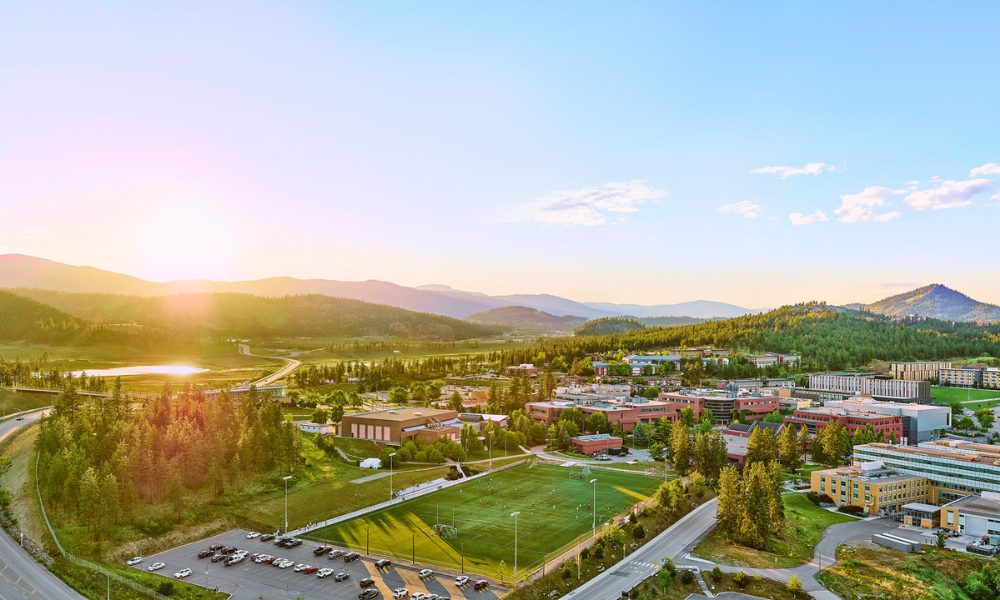
1184 graduate students
441 doctoral students
40% international graduate student population
110 countries represented
24:1 student to faculty ratio
30 international clubs
138 clubs and course unions
200+ public events hosted per year

50% of graduates stay in the Okanagan
30+ beaches
30+ regional parks
100s of trails
200+ freshwater lakes
3 ski resorts within a 90 minute drive
300+ restaurants & cafés
12 art galleries and museums
Explore more facts and figures about our campus and the Okanagan Valley.
From exploring the limitations of Western trauma theory on the Global South to delving into infant feeding practices and sleep behaviours to assessing the sustainability of Urban Water Systems our current international PhD students are positively impacting the world around them. Read more about their research and what brought them to UBC Okanagan.
We have 23 doctoral programs and 9 faculties and schools at UBC Okanagan.
| View Programs | Explore Faculties and Schools |
Deadlines vary by program, so check program-specific requirements and timelines.